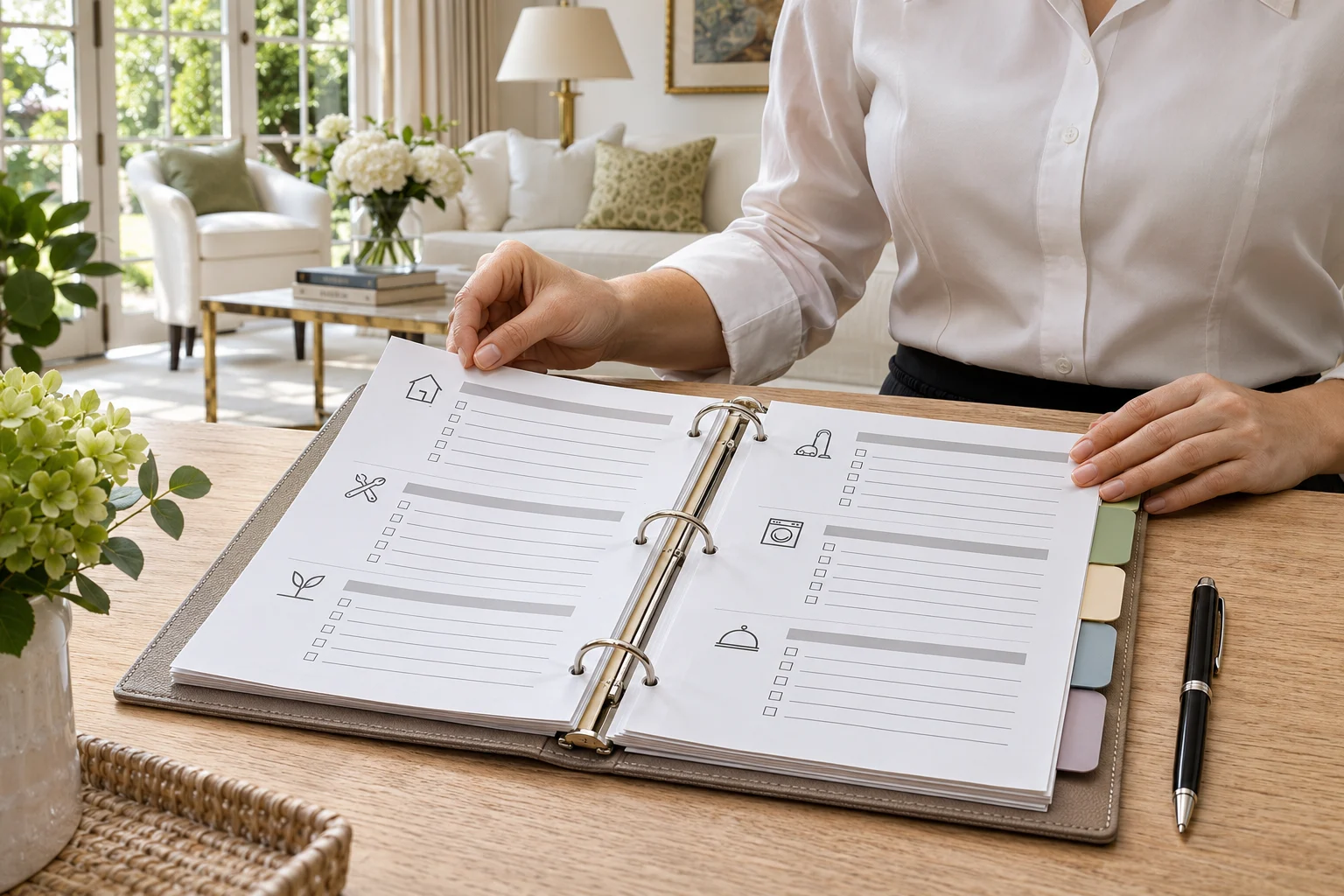
A household manual should make daily life easier, not give your team another document to maintain. Its purpose is simple: explain how your home works, what good service looks like and where to find the information needed to carry out a task.
The most useful manual is not necessarily the longest. It is the one someone can consult before preparing a guest room, receiving a delivery or covering a colleague’s duties without interrupting the household for answers.
Whether you live in one residence or divide your time between several homes, start with the routines people repeatedly need to clarify.
Start With the Questions Your Team Already Asks
Before writing procedures, spend a week collecting recurring questions. Which deliveries need approval? How should a room be left after use? Who should be told when supplies are running low?
These questions reveal where instructions are missing or inconsistent. Organise them into three groups: daily routines, occasional tasks and situations requiring a decision.
Write the first version around those real needs. A short manual that resolves everyday uncertainty is more useful than a comprehensive document filled with procedures nobody follows.
What Should a Household Manual Include?
Build the manual around information that helps someone act. These seven sections provide a practical starting point:
- Household overview: usual routines, shared spaces and the responsibilities assigned to each role.
- Daily and weekly tasks: what needs doing, when it should happen and how completion is recorded.
- Room standards: agreed layouts, preparation checklists and care instructions for furnishings.
- Hospitality preferences: approved details for meals, refreshments and guest-room preparation.
- Supplies and deliveries: storage locations, reorder points, purchasing approvals and delivery arrangements.
- Maintenance reporting: how to record a fault, whom to notify and where approved equipment instructions are kept.
- Communication and updates: where questions go, who can approve exceptions and who maintains the manual.
Not every home needs every section immediately. Add detail when it solves a genuine operational problem.
Describe the Result, Not Just the Task
“Prepare the guest room” leaves considerable room for interpretation. A useful instruction describes the finished result.
For example, an agreed guest-room checklist might cover fresh linen, working bedside lights, drinking water, checked bathroom supplies and space for luggage. It should also explain when the room must be ready and who confirms completion.
Use a consistent structure for recurring tasks:
Task → Expected result → Timing → Responsible person → When to ask for guidance
Photographs can help explain a preferred table layout or room arrangement, provided they do not reveal private documents, valuables or sensitive details. Use images where they clarify something that would otherwise take several paragraphs to describe.
Separate Household Preferences From Personal Information
A manual does not need to contain everything the household knows.
Keep routine operating instructions separate from passwords, access codes, identity documents, detailed travel plans and sensitive personal records. Where restricted information is necessary, the manual can explain who is authorised to provide it rather than reproducing it.
Guest preferences also deserve care. Record only what is needed for the agreed purpose, restrict access appropriately and review whether the information is still required after a visit.
The aim is to help people deliver consistent service without circulating unnecessary private information.
Make Responsibilities and Approvals Clear
Even a detailed checklist becomes ineffective when nobody knows who owns it.
For each recurring activity, identify the responsible role and the person who covers it during an absence. Explain which decisions can be made independently and which require approval.
For instance, reporting a broken appliance, arranging an approved contractor and authorising a replacement may involve different people. Recording those boundaries helps prevent duplicate instructions and unexpected purchases.
Use role names in the main procedures and maintain current contact details separately. This reduces the amount of rewriting required when the team changes.
For a closer look at how oversight can be divided, read our guide to estate manager and house manager responsibilities.
Keep One Current Version
A printed folder, shared document or secure household system can all work. The important point is that everyone knows which version is current.
Give each section an owner and a last-reviewed date. Keep a brief change log for meaningful updates, such as a revised delivery process or a new purchasing approval arrangement.
Avoid letting important changes exist only in messages. Once a new routine is agreed, update the manual and tell the relevant team members what changed.
For households with several residences, separate shared standards from property-specific instructions. The service expectations may stay consistent while equipment, storage locations and local contacts differ.
Test It Before Adding More Detail
Ask a team member to follow one routine using only the relevant section. Notice where they pause, make an assumption or need clarification.
Those gaps are your editing list.
Check whether the instructions reflect the actual home, whether the required supplies are available and whether the expected result is clear. Revise the procedure before expanding the manual further.
A short review after changes to the household’s routine helps keep the document useful. Remove outdated instructions rather than continually adding new pages around them.
A Practical Starting Point
Begin with five frequently repeated tasks, one responsibility list and a clear process for questions. Test that small version with the people who will use it.
A good household manual supports professional judgement; it does not attempt to replace it. When it explains the essentials clearly, your team can spend less time searching for instructions and more time attending to the household.
To discuss your household’s staffing and support requirements, contact Elite Butlers Global.
Frequently Asked Questions
How long should a household manual be?
There is no fixed length. Include enough detail to carry out recurring tasks consistently, then expand only where questions or mistakes reveal a genuine gap.
Who should maintain the household manual?
Assign one owner to coordinate updates, with input from the people responsible for each area. Changes to household preferences should be confirmed by an authorised decision-maker.
Should every team member see the whole manual?
Not necessarily. General procedures can be shared across the team, while sensitive information should remain accessible only to those who need it.